


- What are dark spots on the skin?
- Why do dark spots appear?
- Types of facial blemishes
- What causes the appearance of sunspots?
- The best products to prevent sunspots
What are dark spots on the skin?
These skin blemishes are a common aesthetic concern that arises when high levels of melanin are produced in a specific body region. This results in hyperpigmentation in the area. Dark spots appear most frequently on the face but also on the hands, neck and décolleté because these are parts of the body most exposed to the sun.
Why do dark spots appear?
Dark spots may appear for many different reasons, but the leading causes are:
- Sun exposure: This is the fundamental factor leading to the appearance of dark spots, especially if no photoprotection is used, such as sunscreen, protective clothing and shade. Sun exposure does not just cause spots during the summer since UV rays are present all year round.
- Genetic factors: Certain skin phototypes or skin tones have a greater likelihood of producing dark spots on the skin. Specifically, darker skin and higher phototypes are more likely to develop this type of spot.
- Hormonal changes: In women, the risk of dark spots increases if hormonal changes occur. These may be due to the use of contraceptives, pregnancy, or menopause, as such changes can alter the formation of melanin in different areas.
- Photoageing: The effect of free radicals and solar radiation damage can cause enhanced skin ageing, known as photoageing. This results in a weakening of the skin's natural protection, which makes it more prone to developing dark spots.
- Ageing: Natural ageing is one of the leading causes of dark spots on the skin. This is because, as we age, the number of melanocytes is reduced, which are cells that produce melanin as a form of protection against the damaging effects of the sun. Those still present in the skin tend to achieve a more focused distribution, so it is common for them to accumulate in some areas, forming dark spots on the skin.
Types of facial blemishes
There are three types of facial blemishes, depending on their characteristics:
Sunspots
Sunspots are oval or round in shape, flat and usually dark brown in colour. These spots generally occur when the skin is not able to maintain its condition after excessive exposure to the sun’s ultraviolet rays. They usually appear in areas most exposed to the sun, such as the face, neck, hands and arms.
Senile spots
Senile spots on the skin, also known as senile lentigines, can vary in color from light to dark brown, and are usually small and rounded in shape. They can be caused by genetics or ageing, hence the name "senile spots." Lentigines can appear anywhere on the body and may increase in number with age.
Pregnancy spots
Facial spots during pregnancy, also called pregnancy masks, are related to the hormonal changes of pregnancy. They are usually coffee-with-milk-coloured brown plaques, which appear on the cheeks, forehead and nose.
Melasma
A melasma is a dark, flat spot that appears on the skin, usually on the forehead, cheeks, and upper lip. It is more common in women and is mainly associated with hormonal changes.
Freckles
These are small brown or black spots that appear on the skin, usually on the face, neck and shoulders. They are more common in people with fair skin and develop due to genetic factors.
Nevus or moles
These are darker patches of skin that can be of different sizes and shapes. Some may be flat, while others may have a raised shape. Some nevi may be present at birth, while others develop over time.
Birthmarks
Birthmarks are spots on the skin that are present at birth or appear shortly after birth. They can vary in size, shape, and color and may be present anywhere on the body.
Remember that it is always important to consult a Dermatologist to check out any new or changing spots on the skin, as they may be a sign of an underlying health problem.

What causes the appearance of sunspots?
Sun exposure is the main factor in the appearance of this type of spot. The skin has cells called melanocytes that produce melanin as a form of protection against the damaging effects of the sun. When the skin is exposed to the sun, melanocytes produce melanin to absorb UV radiation and protect the deeper layers of the skin and the DNA of the cells. However, in some of these areas, such as the face, arms, and shoulders, melanin production and the cells that produce melanin can be altered, resulting in the formation of sunspots.
How can you avoid sunspots?
We are always reminded of the importance of using appropriate sunscreen to prevent or reduce sunspots, but here are some additional tips to prevent sunspots:
Use a sunscreen with high SPF
The use of a sunscreen with a broad-spectrum sun protection factor (SPF) is essential to protect the skin from damage caused by UV radiation. Our sunscreens are formulated with state-of-the-art technology and are suitable for many different skin types. In addition, many products are enriched with antioxidants to provide additional protection against free radicals generated by sun exposure that can contribute to premature skin ageing.
Use depigmented products
Depigmenters are substances that help reduce melanin production in the skin, which can assist in reducing the appearance of dark spots or hyperpigmentation. Common depigmenters include kojic, ascorbic, glycolic, and lactic acid. Discover two more below:
Melasyl has a new mode of action compared with other hyperpigmentation dermatological actives. It acts early in the mechanism of melanin synthesis to avoid its overproduction and the appearance of pigmentary concerns in the form of dark spots on the skin. It intercepts excess melanin at a different stage of its production before it marks the skin, fighting hyperpigmentation like never before and helping to prevent the appearance of pigment irregularities. Clinically tested on all skin tones, Melasyl is the result of 18 years of research at La Roche-Posay.
Niacinamide, on the other hand, is a form of vitamin B3 that has become a popular ingredient in skincare products due to having multiple benefits. Niacinamide has been shown to help improve skin barrier function, reduce inflammation and sebum production, and help to reduce the appearance of dark spots or hyperpigmentation in the skin. Niacinamide can be a gentler alternative to some of the stronger depigmented products, making it ideal for sensitive skin.
The best products to avoid sunspots
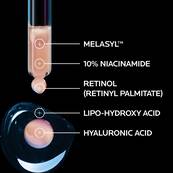
Correct & protect against sun spots with Mela B3 Serum and Anthelios Anti-Dark Spots SPF50+, a routine recommended by dermatologists for skin with sun spots, suitable for all skin types. Mela B3 serum is an anti-hyperpigmentation serum powered by Melasyl and 10% Niacinamide to help correct even persistent sun spots and prevent the appearance of new sun spots. Anthelios Anti-Dark Spots SPF50+ offers broad-spectrum (UVA and UVB) protection against sun exposure – the fundamental factor leading to the appearance of dark spots. It is formulated with Melasyl, to target sun spots, and the UV Filter UVMune 400, the most efficient UV filter for protection against ultra-long UVA*.
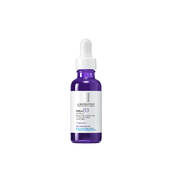


Mela B3 Serum
Finally, our anti-hyperpigmentation innovation MELA B3 Serum corrects the appearance of dark spots, even persistent ones, fades the appearance of stubborn marks, and gives a more even skin tone appearance. Acts to lighten the appearance of existing pigmentation whilst helping prevent the appearance of future dark spot discolouration. MELA B3 is also suitable for those who may be prone to pigmentations caused by external factors such as sun, age, post-acne marks. Co-developed with leading dermatologists and pigmentation experts, MELA B3 combines our new multi-patented Melasyl™ ingredient which intercepts excess melanin at a different stage of its production before it marks the skin. Clinically tested on all skin tones. Honouring the skin’s natural melanin production, MELA B3 respects the natural beauty of our skin, suitable for all tones and types, including sensitive skin. 94% had a clinical reduction in dark spots.*
*50 subjects, instrumental measurement of size and overall are of dark spots after 12 weeks.
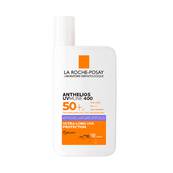
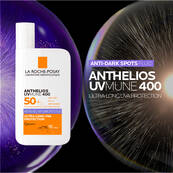
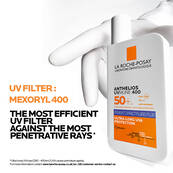
Anthelios Anti-Dark Spots SPF50+
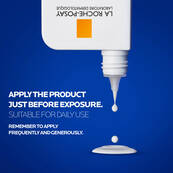
Anthelios Anti-Dark Spots SPF50+ is a light-weight, non-greasy fluid specifically formulated for those who suffer from hyperpigmentation and dark spots, preventing sun-induced dark spots and hyperpigmentation. It targets tone evenness, skin radiance and the intensity and visibility of dark spots with the active MelasylTM. Formulated with our revolutionary UV Filter UVMune 400, the most efficient UV filter for protection against ultra-long UVA*, the formula protects against UVA and UVB rays.
In short, sun protection and depigmenting components are two of the most important aspects when it comes to combating these skin blemishes and keeping skin healthy looking and radiant. Whatever type of skin blemishes you have, La Roche Posay has formulations and sunscreens for all skin types, with various compounds according to your needs.


